52% more participation
Decreased pre-op labor
Billable from day one

H3A Health Analytics

Pre-Surgical Assessment Platform - 2018-2020

Designing Pre-Surgical Care for Patients Who Can't Type, Can't Speak, or Can't Show Up

Scroll
Looking for a Product Designer who designs for the hardest-to-reach users? Let's talk →

01 Design Philosophy

This project taught me that accessibility isn't a feature you add at the end. It's the reason the product exists. The patients who most needed careful pre-surgical assessment were the ones least able to participate in it. Every design decision started from that reality.

A note on confidentiality. This project was completed under NDA. I'm unable to show all production screens, patient-facing UI, or proprietary clinical workflows. What follows includes select platform views alongside a detailed account of my design process, decision-making, and measurable outcomes. I'm happy to walk through additional detail in a conversation. If you'd like to see the depth of my interface work, the Walgreens and Skyello case studies include full production screens.

Recruiter TL;DR - 30 seconds11 min read

  • Product Designer on HIPAA-compliant pre-surgical assessment platform
  • Designed two parallel communication paths (text questionnaire + video consultation) for patients with varying capabilities
  • 52% increase in pre-surgery patient participation in questionnaires
  • Decreased labor at patient arrival with pre-populated clinical data
  • Created insurance-billable clinical encounters from a communication tool
  • Designed for the full spectrum of patient impairment: motor, cognitive, visual, language barriers

Role

Product Designer (2018-2020)

Scope

End-to-end UX design, agency project

Domain

Healthcare, pre-surgical assessment, patient-physician communication

Core Challenge

Reaching patients with physical impairments, cognitive limitations, or language barriers

Before surgery, anesthesiologists need specific information: allergies, current medications, pre-existing conditions, reactions to prior anesthesia. The standard process was a phone call. But that process excluded the patients who needed the most careful assessment.

Patients who couldn't speak couldn't complete the call. Patients with cognitive impairments couldn't process rapid-fire clinical questions. Patients with motor impairments could talk but couldn't type - making digital forms useless. Patients who didn't speak English fluently couldn't navigate either channel. Elderly, homebound, or assisted care patients couldn't show up for in-person pre-op visits.

The gap was clear: patients who most needed careful pre-surgical assessment were least able to participate in it. Clinical teams compensated at point of arrival - more time in pre-op, more questions under pressure, more decisions with incomplete information.

The Gap

What Anesthesiologists Need

Allergy history
Current medications
Pre-existing conditions
Prior anesthesia reactions
Specific patient data before surgery

Phone Calls + Paper Forms

Broken bridge

Patient Populations Excluded

Can't speak
Can't type
Cognitively impaired
Language barriers
Homebound / assisted care

The patients who most needed careful pre-surgical assessment were the ones least able to participate in it.

The Prior State - How Pre-Surgical Assessment Worked Before H3A

1

Surgery Scheduled

Patient is booked for a procedure. The anesthesiologist needs a pre-surgical assessment completed before the day of surgery. A clinical team member is assigned to collect the data.

2

Phone Call Attempt

A staff member calls the patient to walk through assessment questions: allergies, medications, prior surgeries, anesthesia reactions. The call is the only remote option. No alternative channels exist.

Fails for 5 populations
3

Paper Form Fallback

If the call fails, a paper form is mailed or given at a pre-op visit. The patient fills it out by hand (if they can), mails it back (if they remember), and someone manually enters the data (if it's legible).

Fails for motor/cognitive impairment
4

No Assessment Completed

For patients who couldn't complete either channel, the assessment simply didn't happen. No data was collected. The clinical team moved forward without it.

Patient safety gap
5

Day of Surgery - Scramble

Patient arrives. The anesthesiologist has incomplete or no pre-surgical data. Assessment questions are asked under time pressure in pre-op. Delays cascade. Decisions are made with missing information. Risk increases.

Clinical risk

Patients left behind by this process

Can't Speak

Intubated, tracheotomy, severe speech disorders

Can't Type

Parkinson's, arthritis, motor impairment, tremors

Cognitive

Dementia, stroke recovery, processing disorders

Language Barrier

Non-English speakers, limited fluency, medical terminology

Homebound

Elderly, assisted living, mobility limited, can't travel to pre-op

What happened when assessment didn't happen

+45 min

Added to pre-op when data was missing

Blind

Anesthesia decisions with incomplete history

$0

No billable encounter generated

Elevated

Patient safety risk from missing data

Six constraints defined every trade-off. They came before the design, not after.

HIPAA compliance across every channel

Text messages, video calls, questionnaire responses all had to meet healthcare data privacy requirements as foundational architecture.

Accessibility across the full spectrum

Not WCAG checkbox accessibility. Designing for patients who physically couldn't interact with standard interfaces - Parkinson's, stroke recovery, dementia with caregiver mediation.

Variable tech literacy

From smartphone-native to never-touched-a-tablet. First-time use had to be successful use. No learning curve allowed.

Clinical data accuracy

A misunderstood question or incorrect allergy could have life-threatening consequences. Unambiguous and clinically precise in plain language.

Insurance billing requirements

Platform had to generate billable encounters, meet documentation standards for insurance reimbursement. Shaped encounter structure.

Multi-stakeholder design surface

Anesthesiologists, patients, hospital administrators, billing departments. Each interacted differently, one system.

Core insight: patients aren't a monolith. A single communication path would always exclude someone. The solution was two parallel paths that converged to the same clinical output.

Path 1: Text-Based Questionnaire - for patients who could read and interact with a screen but couldn't speak or preferred async. Send a link, complete on their own time, at their own pace, on their own device. No scheduling required.

Path 2: Video Consultation - for patients who could speak but couldn't type or read well. Scheduled video call with a clinical team member. Walk through questions verbally, observe non-verbal cues, capture information in real time.

Both paths produced the same clinical output: a completed pre-surgical assessment that met documentation standards and was billable to insurance. Patient capability determined the path, not the system's convenience.

Two-Path Architecture

Patient

Capability assessment

Path 1: Text Questionnaire

Can read/interact with screen. Can't speak or prefers async. Own time, own pace, own device.

Path 2: Video Consultation

Can speak but can't type/read well. Scheduled call with clinical team. Non-verbal cues captured.

Same Clinical Output

Completed assessment + billable encounter

Patient capability determines the path, not the system's convenience.

Plain language without clinical ambiguity. "Have you ever had a bad reaction to anesthesia?" captures the same information as clinical terminology but doesn't require medical literacy to answer. Every question went through clinical review and plain-language translation.

Pacing for patients under stress. Short sections, clear progress indicators, ability to pause and return. Pre-surgical patients are anxious. The questionnaire had to respect that state, not add to it.

Large, forgiving interaction patterns. Touch targets designed for impaired motor control. High contrast throughout. No sliders, no drag-and-drop, no small checkboxes. Every interaction was a large, tappable surface area that didn't punish imprecise input.

Clinical Translation

Clinical Terminology

History of adverse anesthetic events
Current pharmacological regimen
Documented drug hypersensitivities
Comorbid conditions assessment
Previous procedural complications

Plain-Language Patient Question

Have you ever had a bad reaction to anesthesia?
What medications do you take every day?
Are you allergic to any medicines?
Do you have any ongoing health conditions?
Have you had problems during past surgeries?

Zero-learning-curve entry. Receive link, tap, in the call. No app download, no account creation, no permissions dialogs. Every barrier removed between the patient and the clinician.

Minimal on-screen controls for the patient: clinician's face, end call, mute. That's it. Nothing else on screen to confuse, distract, or require explanation.

Clinician side designed for speed. Patient video, assessment questions, documentation fields, and patient record all visible simultaneously. The asymmetry was intentional - the patient sees simplicity, the clinician sees everything they need to work efficiently.

Intentional Asymmetry

Patient Side

Clinician's face (full screen)
Mute button
End call button

3 elements total. Nothing to learn.

Clinician Side

Patient video feed
Assessment questions panel
Documentation fields
Patient medical record
Encounter timer and billing codes
Non-verbal observation notes

Information-dense. Designed for clinical speed.

Video Consultation - Clinician View
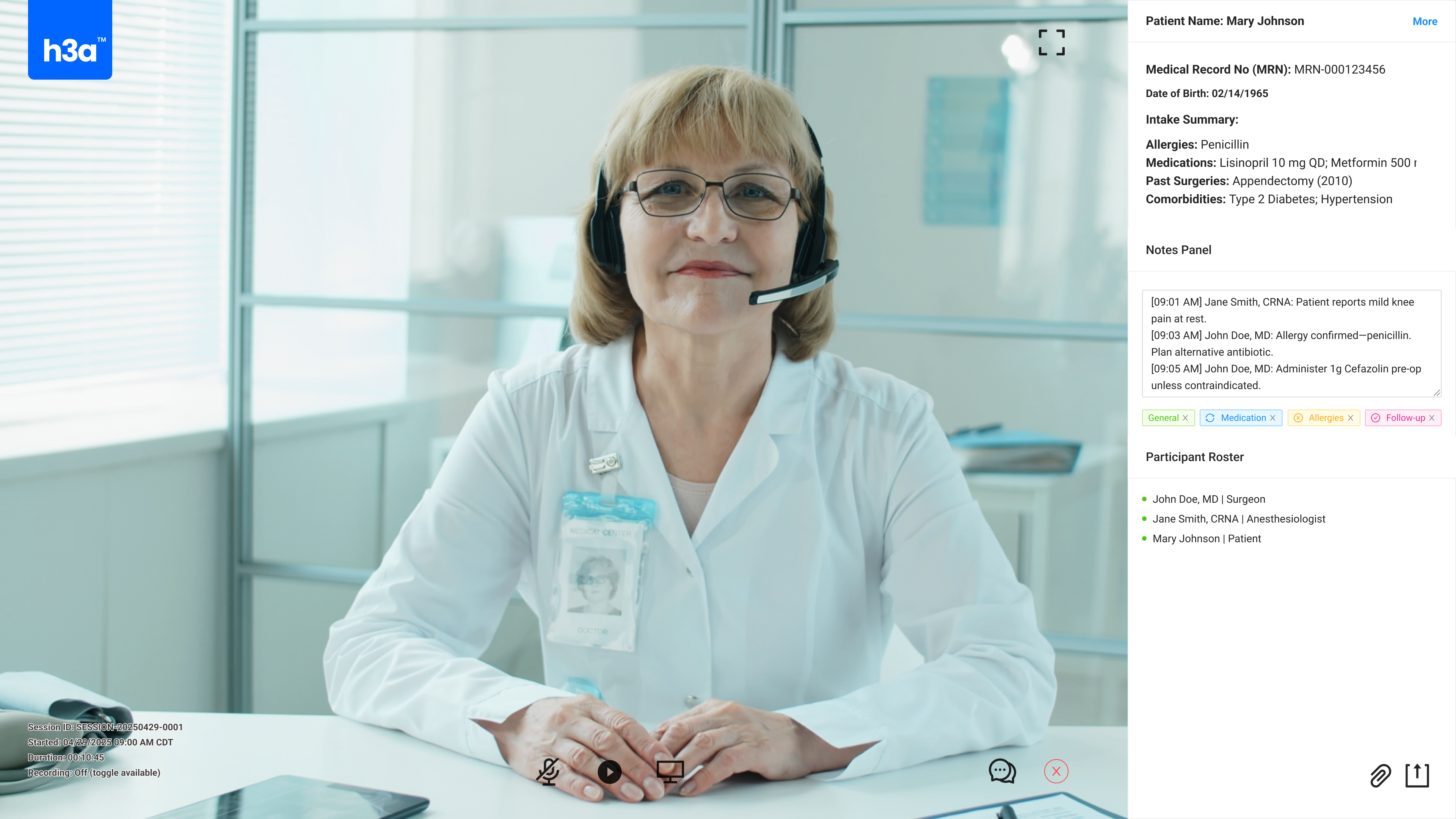
H3A video consultation interface showing clinician view with patient video, medical record, and notes panel

Patient video, medical record, notes, and participant roster visible simultaneously. Click to enlarge.
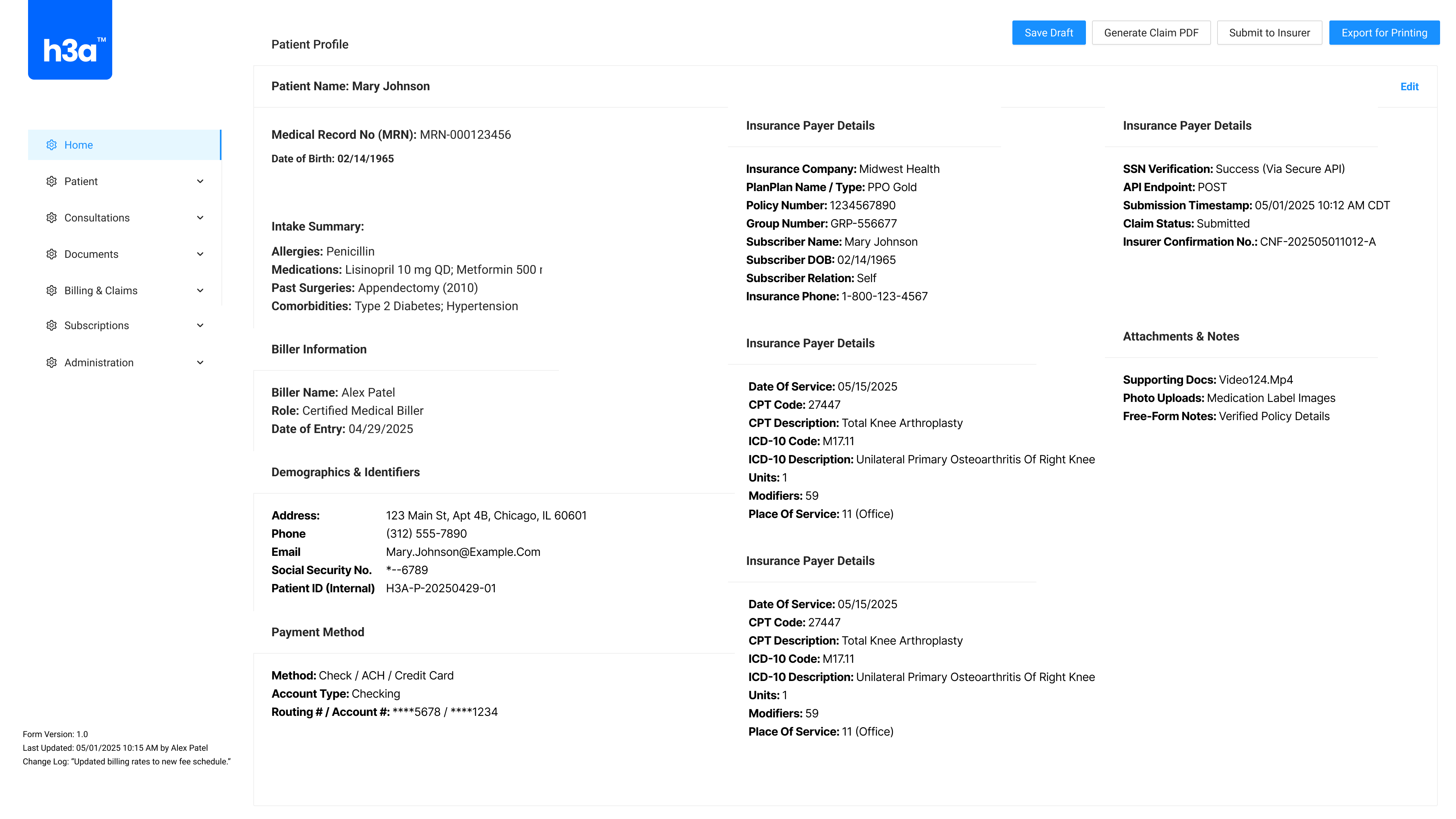
Every completed assessment had to produce a documented encounter meeting insurance billing standards. This wasn't an afterthought - it was a core design constraint that shaped the entire encounter structure.

Encounter documentation was structured to meet billing codes. Video consultations were logged with clinical detail sufficient for reimbursement. Questionnaire completions were matched to the same documentation standard as in-person assessments. The platform didn't just improve communication - it created a new billable service line.

Assessment to Billing Flow

01

Patient completes assessment

02

Clinical record auto-generated

03

Meets billing code requirements

04

Submitted to insurance

Patient Profile & Billing Administration

H3A patient profile with billing details, insurance payer information, and claims data

Patient intake, insurance details, CPT/ICD-10 codes, and claim status in one view. Click to enlarge.

52%

Increase in pre-surgery patient participation

Decreased

Labor at patient arrival with pre-populated data

Billable

Insurance-billable encounters from day one

Patients who previously had no way to participate in pre-surgical assessment now had two paths to care, matched to their capabilities. The platform didn't just digitize an existing process - it reached populations that the existing process had structurally excluded.

Skills Demonstrated

Enterprise UX Healthcare/HIPAA Accessibility Design User Research Clinical Workflow Design Business Strategy & ROI Thinking Multi-Stakeholder Communication Plain Language Design

Not everything landed the first time. Some of the hardest lessons came from designs that were technically sound but practically wrong.

First questionnaire designs were too long. I tried to capture everything in the initial version. Clinicians helped me prioritize - cut the nice-to-haves, keep the questions that directly impacted anesthesia decisions. Shorter questionnaire, higher completion rate.

Video call reliability was outside my control but inside my responsibility. Network quality, device compatibility, browser support - all variables I couldn't control but patients would blame the product for. I designed graceful degradation, auto-reconnect flows, and fallback to text when video failed.

Caregiver-mediated interactions were underestimated. Many patients had a family member or aide completing the assessment on their behalf. Consent flow, question framing, and identity verification all needed adjustment post-deployment to handle this pattern properly.

Iteration Timeline - Key Pivots

Early 2019

Questionnaire too long

Prioritized with clinicians. Cut non-critical questions. Completion rate improved significantly after shortening.

Mid 2019

Video reliability issues

Designed graceful degradation and auto-reconnect. Added text fallback when video failed. Patient trust maintained.

Late 2019

Caregiver mediation gap

Rebuilt consent flow for proxy completion. Added identity verification layer and caregiver-specific question framing.

Accessibility isn't a checklist - it's the product. The entire product existed because standard interfaces excluded people who needed care most. WCAG compliance was necessary but insufficient. Real accessibility meant designing for patients with Parkinson's trying to tap a button, for dementia patients whose caregiver was answering on their behalf, for stroke recovery patients who could speak but not read. The accessibility was the value proposition.

The business model is a design constraint. Insurance billing requirements shaped design decisions as much as user needs did. The encounter structure, the documentation format, the timing of data capture - all of it had to satisfy billing codes or the product had no revenue model. Understanding that constraint early meant designing with it, not against it.

Designing for impairment means designing for reality. Design for the worst-case version of every user, not the best-case. If the interface works for a patient with tremors, impaired vision, and limited English - it works for everyone. That framing changed every design decision from "what's the ideal interaction" to "what's the most forgiving interaction."

Key Insight

When accessibility is the value proposition, not a compliance requirement, it changes how you prioritize every design decision. The patients who were hardest to reach were the reason the product existed - not an edge case to handle later.

Accessibility was the value proposition, not a compliance requirement.

Previous: Walgreens Next: Skyello

Next Case Study

Skyello

View case study

Tabari Seward

Product Designer specializing in enterprise healthcare, accessibility-first design, and reaching the hardest-to-serve user populations. Turning complex clinical workflows into tools that include everyone.

Resume